

NewsDetails
Buttweld Pipe Fittings Guide - Elbows, Tees and Reducers
author:Jinyuan time:2026-11-07 11:42:22 Click:80
Introduction
Buttweld fittings change direction, branch a line or change diameter, and they do it with a welded joint that is as strong as the pipe itself. Because they are welded, the fitting dimensions, wall thickness and material must match the pipe exactly; a small mismatch in bore or wall produces misalignment, root gaps and stress concentration at the joint. ASME B16.9 governs the dimensions of wrought buttweld fittings.
Elbows: Long Radius and Short Radius
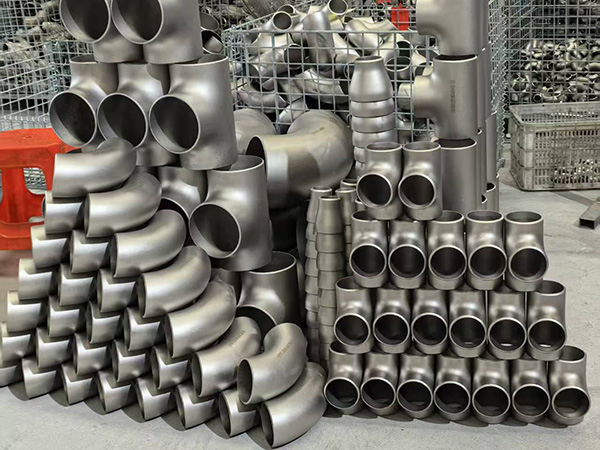
A long radius elbow has a centre to end dimension of 1.5 times the nominal diameter, while a short radius elbow uses 1.0 times. The long radius version produces lower pressure loss and gentler flow transition and is the default choice for most piping. Short radius elbows are used where space is restricted, accepting higher turbulence and slightly greater erosion at the outer radius.
Elbows are supplied in 45 and 90 degree forms most commonly, with 180 degree returns available for specific configurations. The ends are bevelled to match the pipe preparation so that the field or shop weld uses the same procedure as a pipe to pipe joint.
Tees: Equal and Reducing
An equal tee branches a line at the same diameter, while a reducing tee branches to a smaller size. The branch connection is the highest stress region in most piping systems, because the run pipe wall is interrupted and the branch load is transferred through a saddle weld. For high pressure or cyclic service, a reinforced tee or a weldolets and sweepolet type fitting may be specified instead of a standard tee.
Barred tees are used where a pig or cleaning device must not enter the branch. They are common in pipeline launcher and receiver stations and in lines that are internally inspected.
Reducers: Concentric and Eccentric
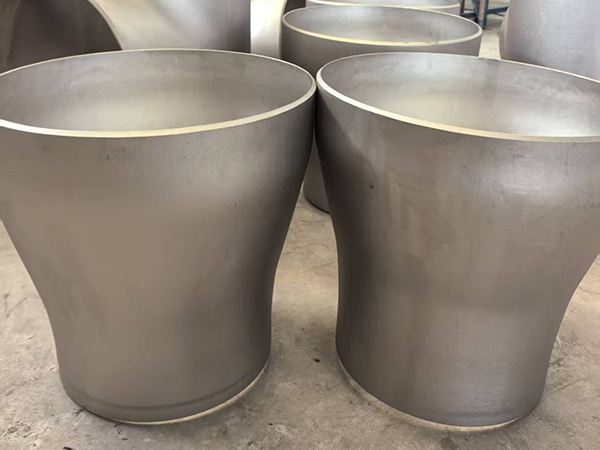
A concentric reducer tapers symmetrically and is used in vertical lines or where the line remains full. An eccentric reducer has one side flat, which allows the line to drain completely or to avoid trapping gas at a high point. In horizontal liquid lines the flat side is placed at the bottom to prevent air pockets; in horizontal gas lines it is placed at the top to prevent liquid accumulation.
Getting this orientation wrong is one of the most common installation errors in pump suction and compressor piping, and it produces vibration, cavitation or water hammer rather than an immediate leak.
Caps, Stub Ends and Bends
Caps close a line end with a domed shape that distributes pressure efficiently. Stub ends are used with lap joint flanges to allow flange rotation. Bends, produced by hot or cold induction bending, provide a smoother transition than a fabricated elbow and are common in large diameter transmission lines where pressure loss and pigging clearance matter.
Bends also reduce the number of girth welds, which is significant in high pressure gas lines where weld inspection cost is a large part of the total.
Material and Wall Matching
Fittings must match the pipe in grade and, in most cases, in wall thickness. A fitting with a heavier wall than the pipe creates an internal step that is acceptable in some codes but must be specified, since it affects pigging and internal inspection. A fitting with a lighter wall is generally not acceptable without a design check.
For alloy and stainless systems, the fitting must be heat treated and pickled to match the pipe, otherwise the weld and heat affected zone will have different corrosion resistance from the parent material.
Inspection and Documentation
Fittings should be supplied with dimensional inspection, material certificates traceable to heat number, and non-destructive testing where the specification requires it. For critical service, hardness testing and impact testing are added. Markings on the fitting should include size, wall, grade and heat number, and they should remain legible after coating.
Hebei Jinyuan Pipeline Equipment Co., Ltd. supplies elbows, tees, reducers, caps and bends in carbon, stainless and alloy steels, with dimensions to ASME B16.9 and material certificates issued per lot.
Conclusion
Buttweld fittings are simple components with precise requirements: correct type for the duty, correct radius, correct orientation of eccentric reducers, and correct wall and grade matching. Specifying by size and grade alone leaves the most consequential details to the supplier, which is rarely the intention of the designer.
References
[1] API Spec 5L: Specification for Line Pipe.
[2] ISO 3183:2019 Petroleum and natural gas industries – Steel pipe for pipeline transportation systems.
[3] ASME B36.10M: Welded and Seamless Wrought Steel Pipe.
[4] ASME B16.5: Pipe Flanges and Flanged Fittings, NPS 1/2 through NPS 24.
[5] ASME B16.9: Factory-Made Wrought Buttwelding Fittings.
[6] ISO 21809-1:2018 External coatings for buried or submerged pipelines – Polyolefin coatings (3PP and 3PE).
[7] EN 10204:2004 Metallic products – Types of inspection documents.
 Recommended Products
-
Carbon Steel Flanges for Pipe to Pipe Connections
-
Carbon Steel Elbow in Bulk Supply for Plant Piping
-
Large Diameter Concentric Reducer for Transmission
-
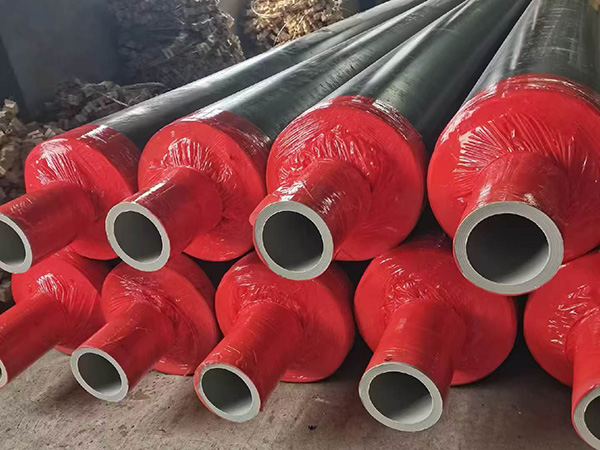
Polyurethane Foam Insulated Pipe with Protected Ends
-
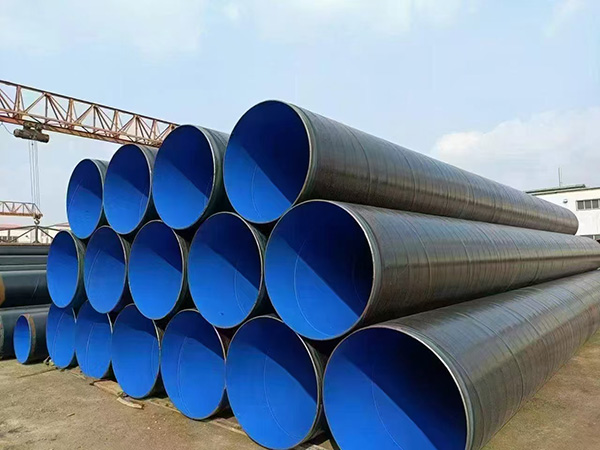
3PE Anti Corrosion Pipe with Internal Epoxy Lining
-
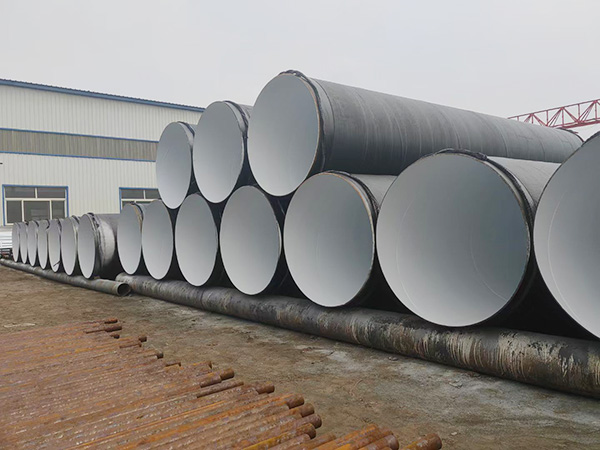
FBE Powder Coated Pipe for Underground Water Mains
Contact us
—— Contact:Manager
—— Tel:+86 18831780999
—— Email:960382820@qq.com
—— Url:https://www.jinyuanpipe.com
—— Address:Yanshan County Economic Development Zone, Cangzhou City, Hebei Province, China